

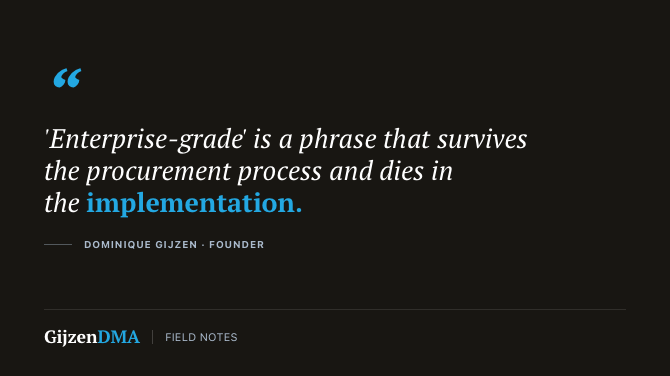
“Enterprise-grade” is a phrase that survives the procurement process and dies in the implementation. It promises everything and specifies nothing.
By the time it has been negotiated into the SOW, the actual question — what scale, what blast radius, what cost ceiling — has been quietly skipped. The answer is whatever the vendor is selling that quarter, dressed up to look like a decision.
We choose the right tools for the right scale. Different stacks, different costs, whatever fits the situation. A 40-person manufacturer does not need the architecture of a hyperscaler, and pretending otherwise is the most expensive way we know to slow a project down.
What we ask instead
The four questions that replace “enterprise-grade” on day one:
- How many users will actually open this on a Tuesday morning?
- How many events per second on the busiest day of the year — not the average?
- What is the tolerance if this is offline for four hours?
- Who is going to operate it, and how senior are they?
The answers are usually surprising. The busiest day is not the day anyone budgeted for. The four-hour tolerance is six hours, in practice. And the operator is one person, half-time, with three other systems already on their plate.
“They told us in week two what we’d been arguing about for a year.”
That quote came from a logistics client who had spent twelve months evaluating a platform they did not need. The answer was three tools, none of them on the original shortlist, and a six-week implementation. The bigger conversation was the one that wasn’t happening.
The shape of the answer
It usually fits on one page. A diagram, the three tools, the cost at the scale you actually have, and the cost at three times that scale. If it doesn’t fit on one page, the architect hasn’t finished thinking yet.
The page is also the handover. The point is not that we built it — the point is that you can run it, change it, and explain it without us in the room.